
The Newcastle area is on the traditional country of the Awabakal and Worimi peoples, whose cultural connections with the land and waters extend back tens of thousands of years.
A city whose history is still visible
Coal has shaped Newcastle from the earliest years of European settlement. Coal was identified around the mouth of the Hunter River in the late 1700s, and a permanent penal settlement was established in 1804. Convicts worked in coal mining, timber cutting and other labour-intensive industries, laying some of the foundations for Newcastle's later development as an industrial and port city.
That story isn't confined to museums. Several places around the city centre and coastline still connect directly with it.
At Fort Scratchley, the headland was associated with some of Australia's earliest European coal mining before becoming part of Newcastle's harbour defences. The fort was completed in 1882, and in June 1942 its guns returned fire on a Japanese submarine during the bombardment of Newcastle. City of Newcastle describes it as the only Australian coastal fort to have fired on an enemy vessel during World War II.
Further south, the Bogey Hole was cut into the coastal rock by convict labour for Commandant James Morisset in the early 19th century. It now sits just below King Edward Park and is one of the clearest places to see how Newcastle's colonial history and coastline overlap.
The city's industrial story continued well beyond the convict era. Newcastle Museum occupies former railway workshop buildings dating from the 1880s and early 20th century, with exhibitions covering coal mining, railways, steelmaking and the city's development.
Follow the coast from Nobbys to Merewether
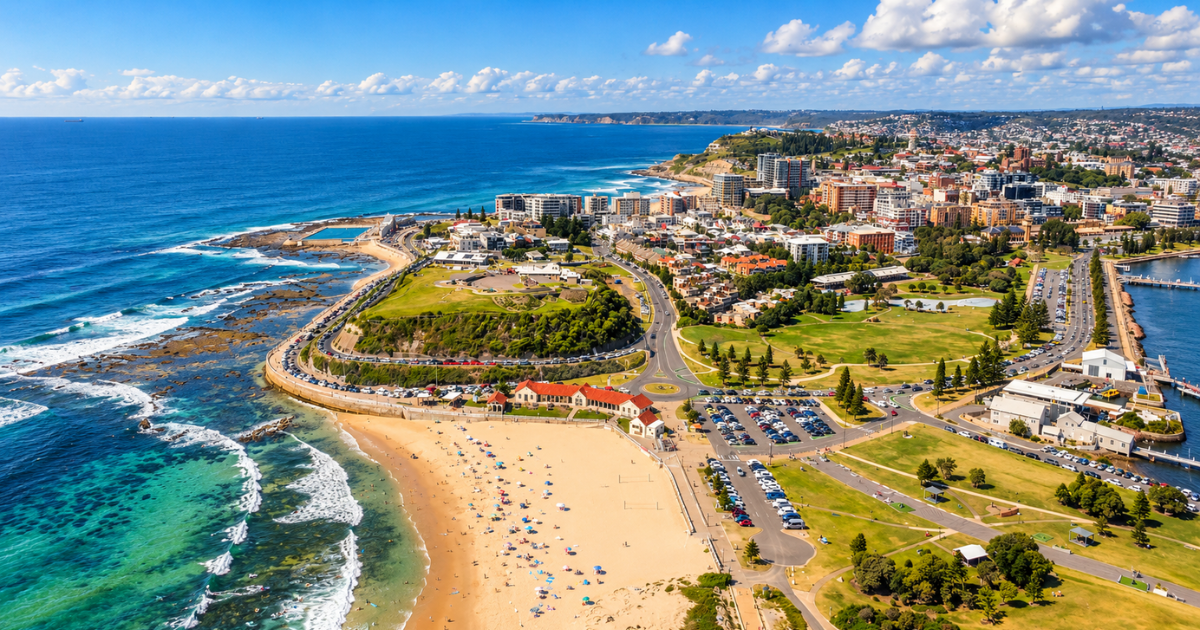
One of the easiest ways to understand Newcastle's layout is to follow Bathers Way. The coastal route runs for about 6 kilometres between Nobbys Beach and Merewether Ocean Baths, linking beaches, lookouts, historic sites and ocean baths along the way.
The northern end begins around Nobbys Beach and Nobbys Head. Macquarie Pier was built during the convict era to connect what was once an island with the mainland and improve the harbour entrance. Nobbys Lighthouse later became part of the city's maritime navigation system and remains an active lighthouse.
Access to the lighthouse precinct is more limited than access to the surrounding beach and breakwall. Visitors walk or cycle along Macquarie Pier rather than drive to the headland, and the final section is uphill. Opening arrangements for the lighthouse precinct can also vary, so it's worth checking before planning a visit specifically to enter the site.
Continuing south brings you past Newcastle Ocean Baths, formally opened in 1922. The pools and lower promenade have undergone a major accessibility and safety upgrade, while further work on the pavilion precinct has been progressing separately. The baths remain a functioning public swimming facility rather than simply a heritage attraction.
Above the coast, the Newcastle Memorial Walk adds another layer to the city's history. The 450-metre walk was built to commemorate both the centenary of the ANZAC landing at Gallipoli and the beginning of steelmaking in Newcastle. Its steel silhouettes and inscriptions recognise Hunter residents who enlisted during the First World War.
Bathers Way eventually reaches Merewether Ocean Baths, opened in 1935. Newcastle and Merewether both offer ocean-bath swimming, but the experience is different: Newcastle Ocean Baths places you close to the city centre and Newcastle Beach, while Merewether sits at the southern end of the coastal walk beside the city's major surf beaches. Both are open year-round subject to cleaning, maintenance and conditions.
Fort Scratchley or the coastal walk?
If time is limited, the choice comes down to what part of Newcastle you want to understand.
Choose Fort Scratchley if the city's military, coal-mining and harbour history is the priority. Entry to the grounds and museum rooms is free, while guided tunnel tours are paid. The tunnels involve narrow stairs and passages and aren't suitable for wheelchairs, walkers, prams or strollers. Some exterior areas also have steep or uneven access.
Choose Bathers Way if you want to see how Newcastle's beaches, baths, headlands and historic sites connect geographically. The full route includes hills and descents, so shorter sections can make more sense for people who don't want to tackle the entire coastal walk. Council is progressively improving step-free accessibility along the route.
With more time, the two fit naturally together. Fort Scratchley sits near the northern end of the coastal route, above Newcastle Beach and close to Nobbys.
Newcastle's recurring events
Several major events use Newcastle's coastline, city centre and public spaces rather than being confined to a single venue.
Surfest has been part of Newcastle's calendar for decades, bringing international competitive surfing to Merewether Beach. Current official visitor information places the event in the early part of the year, although exact dates change, so the event schedule should be checked before planning around it.
New Annual is Newcastle's citywide festival of art, music and ideas. It runs across multiple cultural venues and public spaces, with performances, installations, exhibitions and family programming. Recent editions have been staged over around 10 days in spring, but individual dates and programs change from year to year.
Newcastle Food Month takes place across the city during April, bringing together restaurants, chefs and special dining events rather than concentrating activity at one festival site.
For changing dates and one-off events, the official Newcastle events calendar is the best place to check what's running during a particular visit.
A useful way to explore Newcastle
Newcastle makes more sense when its harbour, coastline and industrial history are treated as parts of the same story.
Start around Nobbys and the harbour entrance if you want to understand the city's maritime setting. Add Fort Scratchley for the military and coal-mining connections, then follow part of Bathers Way towards Newcastle Ocean Baths, the Bogey Hole and Memorial Walk. Head back towards Civic and Newcastle Museum when you want the broader story of rail, coal, industry and the city's changing urban centre.
It's a compact way to see why Newcastle isn't simply a beach destination or an old industrial city. It is both, and many of its most interesting places sit exactly where those histories meet.


